

 2026-08-25

Since 2024, the global roll‑out of industrial AI has kept gathering momentum. According to Industrial AI Market Report 2025‑2030 published by IoT Analytics in August 2025, the global industrial AI market reached USD 4.36 billion in 2024 and is projected to rise to USD 15.39 billion by 2030, representing a compound annual growth rate (CAGR) of approximately 23%.
A 2025 manufacturing AI survey commissioned by Rootstock Software and conducted by Researchscape sampled 369 manufacturing enterprises with over 100 employees across the United States, the United Kingdom and Canada. More than 77% of the surveyed manufacturers have deployed some form of AI technology, up from 70% in 2023.
Europe, the United States, Japan and South Korea are key players driving intelligent factory upgrades worldwide. Real‑world large‑scale deployment nonetheless reveals a critical reality: despite rapid iteration of general‑purpose large models in consumer and office scenarios, they consistently fail to fit complex industrial environments such as precision manufacturing, process‑based chemical production and high‑end semiconductor manufacturing.
I. Structural Conflict Between General‑Purpose Technology Paradigms and Vertical Manufacturing Processes
This structural conflict constitutes the core barrier preventing global industrial AI from moving beyond pilot trials toward full‑scale, widespread adoption.
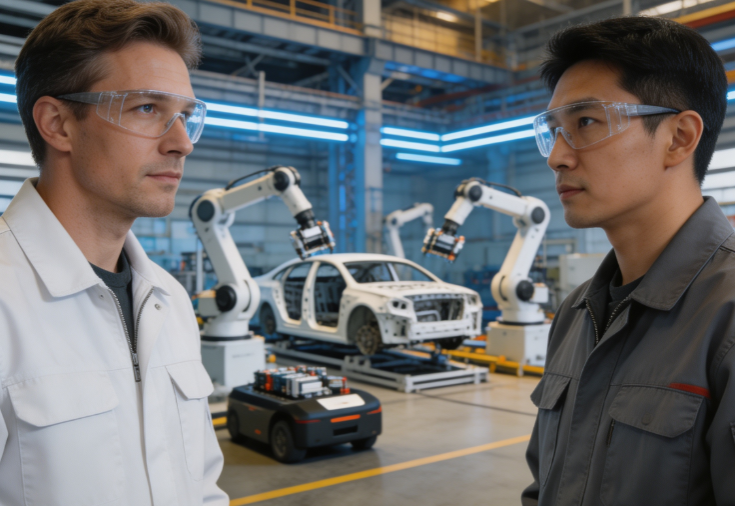
Industrial AI operates under rules distinct from consumer‑grade AI. Its value derives largely from sensor time‑series data, machine vision and edge‑side simulation, and it requires stable integration with OT (Operational Technology) systems. Under this underlying logic, there exists an inherent mismatch between the broad general knowledge capability of general‑purpose models and the stringent process accuracy demanded by real‑world industrial sites.
II. Differentiated Deployment Paths across Europe, the US, Japan and South Korea
All four economies are vigorously advancing factory intelligence, yet they have forged differentiated paths built on their respective industrial strengths. A shared trend prevails: emphasis on practical deployment rather than blind iteration of general‑purpose large models.
United States: Cloud‑ecosystem driven, focusing on flexible digital transformation. Leveraging industrial cloud platforms and general‑purpose model ecosystems from leading tech firms, the US prioritizes end‑to‑end factory data connectivity and flexible production upgrades. Key use cases lie in automotive and high‑end equipment manufacturing, where data interoperability optimizes production scheduling and supply‑chain collaboration.
Germany: Built on Industry 4.0, prioritizing reliable engineering‑oriented implementation. Grounded in its mature Industry 4.0 framework, Germany puts high reliability at its core, targeting precision machinery and core automotive component manufacturing. AI is deeply embedded across production workflows, quality inspection and equipment maintenance, with emphasis on engineered vertical solutions.
Japan: Deep expertise in fine manufacturing, leaning toward lightweight AI for targeted efficiency gains. Drawing strengths from high‑end fine chemicals, precision electronics and automotive manufacturing, Japan avoids large‑model computing power races and prioritizes lightweight, embedded AI. Focus areas include micro‑level quality inspection, predictive equipment maintenance and fine‑tuning of process parameters and other niche scenarios.
South Korea: Empowered by industrial strengths, large‑scale roll‑out of edge AI. Capitalizing on standardized production lines in semiconductors and consumer electronics, South Korea deploys edge‑AI hardware and lightweight algorithms at scale.
An August 2024 survey by the Korea Chamber of Commerce and Industry and the Korea Institute for Industrial Economics & Trade reported a 23.8% AI adoption rate among Korean manufacturers. The 1st Smart Manufacturing Innovation Survey, released in April 2025 by the Ministry of SMEs and Start‑ups and the Smart Manufacturing Innovation Promotion Group, indicated that roughly 19.5% of factory‑owning small‑and‑medium enterprises in South Korea have introduced smart‑factory systems.
Common to all four economies is the rejection of indiscriminate stacking of general‑purpose large models in favour of AI implementations tailored to domestic industrial contexts. Differences persist: the US and South Korea emphasize transformation for scalable, flexible and standardized scenarios, while Germany and Japan focus on high‑precision, fine‑grained vertical optimization tightly coupled with manufacturing processes.
III. Four Major Bottlenecks for General‑Purpose Models in Adapting to Complex Manufacturing
The inability of general‑purpose AI models to adapt to complex industrial settings stems not from insufficient computing power or parameter volume, but structural shortcomings across four dimensions: scenario fitness, precision thresholds, industrial logic and real‑time performance. These reflect fundamental misalignment between general‑purpose technologies and vertical industrial systems.
General‑purpose large models excel at iterative general‑cognition tasks, whereas industrial AI demands precise process execution — a natural mis‑alignment in underlying technical logic.
Deficient scenario adaptability: Non‑standard production lines cannot fit standardized algorithms. Complex manufacturing is highly customised and non‑standardised. Production logic varies drastically across lines, processes and equipment. Trained on standardised datasets, general‑purpose models carry rigid algorithms ill‑suited for on‑demand non‑standard workflows on the factory floor. Heavy custom fine‑tuning is required post‑deployment.
Insufficient precision thresholds: Failure to meet micron‑level requirements of high‑end manufacturing. High‑end precision manufacturing and semiconductor industries across Europe, the US, Japan and South Korea demand accuracy down to the micron or even nanometre scale with near‑zero error tolerance. General‑purpose models operate with error margins far exceeding industrial standards; a mere 0.1% missed‑detection rate can trigger mass production defects.
Lack of industrial logic: Process barriers produce reality‑detached decision‑making. Industrial production rests on deep process know‑how and equipment interlocking rules accumulated over decades. General‑purpose models lack foundational understanding of manufacturing workflows and are prone to unrealistic outputs. This is comparable to assigning a broadly knowledgeable general‑education student to operate precision machine tools: broad knowledge cannot replace hands‑on experience of seasoned process engineers.
Inadequate real‑time stability: Mismatch against industrial low‑latency requirements. Continuous non‑stop production lines impose stringent requirements for low‑latency and highly stable AI decision‑making. General‑purpose large models consume substantial compute resources, exhibit high inference latency and produce stochastic outputs. They struggle to satisfy millisecond‑level response demands, and model hallucinations may escalate into production accidents within industrial contexts.
IV. Root Causes and Emerging Global Industrial Trends
The root cause behind poor industrial performance of general‑purpose models lies in disconnection between their training regimes and industrial attributes. Global industrial AI has moved past large‑model parameter races and entered a new era centred on lightweight design, vertical specialisation, process embedding and hardware‑software integration.

General‑purpose large models are primarily trained on public internet text and images to pursue broad generalisation. By contrast, core industrial process data, equipment metrics and production know‑how are highly proprietary, non‑standard and scarce, and cannot be incorporated into generic training corpora. Consequently, general‑purpose models “understand data yet not manufacturing processes”.
Global trends clearly signal a shift from tentative general‑purpose trials toward deep vertical specialisation. Europe, the US, Japan and South Korea have cut investment in general‑purpose large‑model industrial pilots and are heavily investing in industrial‑specific AI. Clear industry directions include lightweight algorithms optimised for edge devices, vertical models bound to proprietary processes, hardware‑software integration for site‑specific deployment, and closed‑loop data cycles to accumulate industrial domain capabilities.
Per IoT Analytics, current industrial AI value concentrates in five key areas: industrial data management/architecture, quality assurance and inspection, edge AI, industrial Copilot systems, and workforce training. MarketsandMarkets forecasts the global manufacturing AI market will expand from USD 34.18 billion in 2025 to USD 155.04 billion by 2030 at a CAGR of 35.3%, with edge‑AI hardware and other niche segments leading growth. *(Note: The two institutions adopt different statistical scopes; figures cannot be directly compared.)*
Core competitiveness for industrial AI rests not on parameter scale or general‑purpose capability, but on process fit, scenario accuracy and operational stability.
V. Industry Insights
Drawing on deployment practices in Europe, the US, Japan and South Korea, global factory intelligence has entered a phase of high‑quality deep development, ending the era of crude technology stacking.
While general‑purpose large AI models can deliver value for auxiliary industrial tasks such as administrative support, data statistics and knowledge retrieval, they cannot satisfy intelligent‑transformation requirements for core production links in complex manufacturing. Directly applying general‑purpose models onto precision‑manufacturing floors amounts to solving highly specialised problems with generic tools.
The core logic for future AI‑driven transformation in global manufacturing will undergo comprehensive restructuring: blind roll‑out of general‑purpose models will give way to vertical industrial‑AI solutions characterised by scenario adaptation, process embedding, stability and controllability.
Ultimate competition in industrial intelligence is not a contest of raw general‑purpose computing power, but a test of capacity for deep integration between vertical manufacturing expertise and AI technology. True breakthroughs in industrial AI are measured not by model size, but by depth of comprehension of real‑world manufacturing sites.
Note on Data Sources: Third‑party market figures cited herein originate from public research reports. Divergences in statistical definitions, sample coverage and publication timelines across institutions mean data cannot be directly cross‑compared and do not constitute recommendations for any investment target.
END
Disclaimer
All texts, images, research articles, market interpretations, industry analyses, compliance briefings, business explanations and related content published on this official website serve solely for general industry information and macro‑market research reference. Intended exclusively for knowledge‑sharing and industry exchange, such content shall not be construed as investment advice, wealth‑management recommendations, transaction guidance, legal‑compliance opinions, tax‑planning schemes or investment‑and‑financing decision‑making bases for any individuals, enterprises or institutions.
ARBORFIRE CAPITAL conducts business in strict compliance with Hong Kong SFC, US SEC and relevant domestic and overseas regulatory rules. Website content is compiled and analysed from publicly available, compliant market policies and industry materials. No forecasts of price movements, return guarantees, risk underwriting or investment promotion statements are made for any individual stock, single fund or specific project. All historical market data and industry‑trend analyses represent objective retrospectives only and do not guarantee future market performance.
Cross‑border capital operations, overseas listings, asset allocation, offshore structuring and family‑wealth management carry market‑related, compliance‑related and policy‑change risks. All users shall make independent and prudent decisions based on personal asset profiles and risk tolerance, and consult licensed legal, tax and financial professionals when appropriate. The Company accepts no legal liability for decisions or outcomes arising from user reliance on content in this document.
No reproduction, modification or commercial use of content on this official website is permitted without formal authorisation from ARBORFIRE CAPITAL.


 热搜榜
热搜榜

