

 2026-09-11

2026 marks a period of intensive mass production trials and prototype iteration for humanoid robots worldwide. Leading players keep rolling out new-generation products, and embodied intelligence has drawn markedly greater attention from capital markets. Often grouped alongside new energy and large AI models as a tech trend promising near-term returns, humanoid robots are, from a rigorous industrial perspective, still undergoing long-term validation in terms of technological maturity, commercialization pathways and supply chain coordination. This article presents an objective overview solely based on public information and industrial research, and does not provide any recommendations for trading individual stocks, funds or specific assets.
I. Misconceptions Behind the Hype
Public data shows that investment and financing activities for humanoid robots remain robust. Statistics from IT桔子 (IT Juzi) record 125 primary-market financing deals for humanoid robots in 2026 as of June 30, raising 44.532 billion yuan, exceeding the full-year 2025 total of 25.987 billion yuan. Meanwhile, China Industry Research Institute estimates China’s humanoid robot shipments hit roughly 14,400 units in 2025, accounting for 84.7% of the global total, and forecasts shipments of around 38,000 units in 2026 and 380,000 units in 2030.

Institutions including Goldman Sachs have released global shipment projections for humanoid robots, such as 51,000 units in 2026 and 76,000 units in 2027. Such figures are scenario-based forecasts and do not represent realized sales or scalable profits. Industrial realities indicate most enterprises are still at the stage of prototype verification, small-batch trial production or pilots in specific scenarios. Mature unified solutions for core capabilities including general locomotion, operation in unstructured environments and long-duration autonomous decision-making have yet to emerge.
Capital enthusiasm can boost R&D and production capacity investment, yet it cannot replace multidisciplinary technological iteration and accumulation of real-scenario data. Equating “rising financing” directly to “near-term commercial success” tends to overlook the cyclical nature of humanoid robotics as an industry combining advanced manufacturing and artificial intelligence.
II. Three Practical Constraints: Technology, Commercialization and Capital
On the technological front, some public research reports summarize the global division of labor as a complementary landscape: the United States contributes algorithms and chips; Japan delivers precision transmission components; China handles complete machine assembly and manufacturing; Europe focuses on safety and standards. Still, technological boundaries keep evolving. North American firms hold advantages in large models, simulation and high-end computing; Japanese companies have deep expertise in harmonic reducers, servo motors and high-precision sensors; Chinese enterprises advance rapidly in complete machine integration, manufacturing cost control and scenario deployment; European players boast richer experience in functional safety, data compliance and industrial collaboration standards.
From a commercial standpoint, industry analysis cited by China National Radio notes that large-scale commercial adoption of humanoid robots remains constrained by cost, reliability, return on investment and production line adaptation. High-end complete robots carry steep unit prices; industrial pilots require process revamping, staff training and maintenance system setup, while household applications raise concerns over safety, price tag and practical functionality. Current deployments are mostly limited to defined tasks such as material handling, assembly, inspection, display and education. Widespread adoption in ordinary households in the short run cannot be guaranteed.
In terms of capital, primary-market funding is concentrated among certain mature teams. Nevertheless, reports from China Financial News warn that crowded PE/VC investment may trigger valuation bubbles, uncertainty over technical routes and overcapacity risks. Humanoid robot development features lengthy R&D and payback cycles. Without core components, control systems or viable delivery capabilities, financing advantages may not translate into sustainable operational strengths.
III. Underlying Logic of a Long-Cycle Industry
Humanoid robotics integrates large AI models, motion control, sensors, precision machinery, materials science and system engineering. Technical progress generally advances incrementally rather than through one-off disruptive breakthroughs. Unlike internet applications that can be iterated and launched quickly, complete robot hardware must go through laboratory verification, field trial operation, reliability and safety certification, and supply chain cost reduction. No single technical leap can independently determine the overall pace of commercialization.
Regarding supply chains, public documents identify core segments including high-performance chips, harmonic or RV reducers, servo systems, encoders, force sensors, batteries, controllers and dexterous hands. Different regions possess respective strengths in these components, which are subject to export controls, certification regimes, production yield rates and cross-vendor interface standards. Supply chain maturity depends not only on individual component performance but also on system compatibility, delivery stability and full-lifecycle costs.
Scenario penetration typically starts in highly structured environments such as factories, warehouses and inspection sites, before expanding to commercial services and eventually the more complex domestic settings. This roadmap is merely a summary of industrial experience instead of a confirmed timeline. Due to disparities in cost, regulations and customer willingness to pay across countries and manufacturers, the sequence and speed of deployment will vary substantially.
IV. Global Division of Labor and Divergent Compliance Rules
Some public research papers describe the regional landscape as a mix of collaboration and competition: innovation led by the United States, manufacturing by China, precision engineering by Japan, standards set by Europe, and specialized component expertise shared by Japan and South Korea. US firms prioritize embodied intelligence, training chips and simulation platforms. Leveraging industrial clusters for automotive, 3C and robot parts, Chinese enterprises push forward mass production of complete robots and accumulation of scenario data. Japanese manufacturers maintain prominent advantages in precision reducers and core servo components. Europe enforces stricter human-robot safety and compliance thresholds via the AI Act, ISO safety standards and Industry 4.0 frameworks.
South Korea continues investment in servo technology, integrated robot systems and group-led R&D, while Germany holds hidden strengths in encoders, force control and industrial automation. Since humanoid robots involve high-end chips, dual-use technologies, cross-border data transfer, occupational safety and product liability, cross-border investment, mergers & acquisitions and listing services require separate assessments of destination jurisdiction regulations, export controls and information disclosure obligations. “Technological leadership” alone cannot serve as the benchmark for compliance judgment.
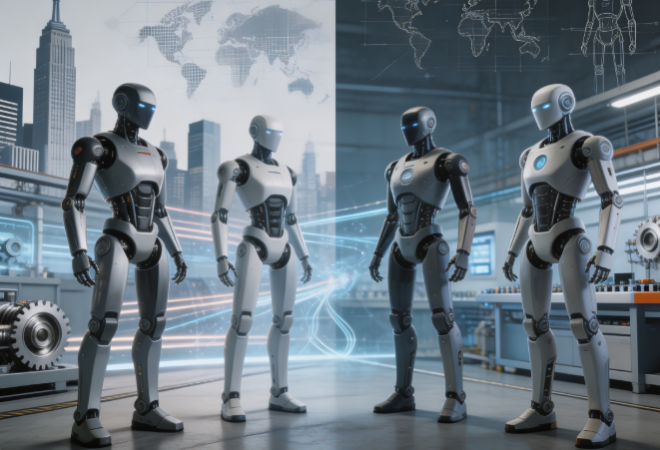
Global competition will not result in dominance by a single nation or enterprise. Algorithms, hardware, application scenarios and standards each form distinct barriers. Regionalized supply chains and mutual certification systems raise long-term costs and extend the overall industrial maturation timeline. For service institutions, greater attention should be paid to compliance frameworks, intellectual property rights, cross-border capital arrangements and multi-jurisdictional regulatory coordination rather than short-lived conceptual hype.
V. Industrial Insight: Long-Termism Defines the Core Track
At its core, the humanoid robot industry features slow elimination and high barriers to in-depth development. Capital and enterprises chasing short-term speculative hype will eventually be weeded out by the market once the tide recedes. Only long-term players committed to technical iteration, supply chain refinement and scenario deep cultivation can weather industrial cycles and capture lasting value.
Preliminary signs of bubble correction have emerged in the sector: some manufacturers lacking core technologies and relying merely on concept promotion face sluggish financing and valuation corrections. In contrast, enterprises with solid technical reserves and proven scenario deployment capabilities continue to secure backing from long-term capital. Looking at the growth paths of global frontrunners — decades of investment in embodied intelligence by North American tech firms, half a century of precision manufacturing accumulation by Japanese and Korean component suppliers, or continuous deep cultivation of supply chains and use cases by leading Chinese manufacturers — there are no quick fixes.
The divide between fad mentality and marathon mentality separates industry participants. Fad mentality pursues short-term valuation premiums, rapid monetization and exit, prioritizing track popularity and conceptual packaging. Marathon mentality focuses on technology accumulation, ecosystem building and delivery of long-term value, respecting the objective laws of industrial development. A market fad is a race for speed and buzz; an industrial marathon is a contest of accumulation, endurance and ecosystem. For enterprises and capital truly aiming to establish a foothold in this sector, abandoning short-term speculative mindsets and adopting a long-term industrial perspective is essential to navigating cycles.
VI. Embark on a Path Toward Certainty with Long-Termism
To recap the core argument: humanoid robots are never a short-lived traffic-driven fad, but a decades-spanning global tech industrial marathon. The complexity of technical iteration, systemic nature of supply chain restructuring, gradual rollout of real-world applications and prolonged global competition all dictate that this journey will be arduous, with no shortcuts available.
Truly transformative industries are never fleeting fads, but enduring marathons that transcend cycles and reshape the future. Moving past impetuous short-term hype and respecting the inherent rules of industrial development, humanoid robots will ultimately remodel production paradigms in global manufacturing and service industries, deeply integrate into human production and daily life, and unlock industrial value on the scale of trillions of yuan. The ultimate winners of this marathon will invariably be the long-termists who advance technology, refine ecosystems and deliver tangible value.
END
Disclaimer
All graphics, research articles, market interpretations, industrial analyses, compliance guides, business briefings and related information published on this official website are for general industry information dissemination and macro market research reference only. The content is intended for knowledge sharing and industry exchange, and does not constitute investment advice, wealth management recommendations, trading guidance, legal compliance opinions, tax planning solutions or financing and investment decision-making bases for any individuals, enterprises or institutions.
ARBORFIRE CAPITAL conducts business in strict compliance with the SFC of Hong Kong, China, the US SEC and relevant domestic and overseas regulatory rules. All website content is compiled and analyzed based on publicly available, compliant market policies and industry materials. The firm makes no predictions on price movements, return guarantees, risk underwriting or investment promotion statements for any individual stocks, single funds or specific projects. All historical market data and industrial trend analyses serve as objective reviews and do not represent future market performance.
Cross-border capital operations, overseas listings, asset allocation, offshore structures, family wealth management and other related businesses carry market risks, compliance risks and policy change risks. All users shall make independent and prudent decisions based on their own asset status and risk tolerance, and consult licensed legal, tax and financial professionals when necessary. The Company shall not bear any legal liability for decisions made by any user based on the content of this article or any consequences arising therefrom.
Without official authorization from ARBORFIRE CAPITAL, no entity may reproduce, alter or commercially use the content on this official website.


 热搜榜
热搜榜

