

 2026-10-27


The global AI industry has long evolved from isolated technology contests into stratified competition across the full industrial chain. A clear value pyramid has taken shape along three tiers: foundation models, computing infrastructure, and vertical applications. Drawing on their respective technological reserves, energy endowments and industrial ecosystems, different regions occupy differentiated niches within the industrial chain.
Beneath this stratified competition lies a multifaceted game revolving around three core factors: technological sovereignty, energy costs and industrial foundations. The ongoing shifts are reshaping the logic of labor division in the global technology sector.
Foundation models represent the commanding technological height of the AI industrial chain and a segment with strong ecosystem control. They not only define the capability boundary of AI, but also lock in downstream developers via API ecosystems and shape the trajectory of technological discourse power across the industry.
The current landscape of global foundation models features oligopolization of general foundation models and regionalization of vertical foundation models. This conclusion is synthesized from publicly available industrial information.
First, the United States sets the technological standards for general foundation models. Leveraging deep fundamental research reserves and abundant capital investment, the United States has gained a prominent first-mover advantage in general large language models. Three vendors — OpenAI, Anthropic and Google DeepMind — collectively shape the mainstream technical routes and performance benchmarks for general foundation models.
Adopting the business model of open APIs, they have built global developer ecosystems that influence technology selection for downstream applications and steer the direction of model iteration.
The three players have distinct technical priorities: OpenAI excels in ecosystem building and commercial deployment; Anthropic focuses on model safety and alignment; Google DeepMind invests heavily in multimodal capabilities and underlying basic research. Together, they have erected substantial technical barriers.
According to a research report published by Gartner in July 2025, global spending on generative AI foundation models reached an estimated USD 13.053 billion in 2025. (This figure follows the independent statistical methodology of a third-party institution. Our entity does not warrant the accuracy or suitability of this data.)

Second, regional second-tier players build regional pivots through specialized foundation models. Most market participants in latecomer economies find it difficult to compete head-on with leading vendors in general foundation models, making differentiated positioning a widely adopted strategy. Drawing on accumulated military industry and research expertise, Israel has developed vertical foundation models tailored for secure and national defense use cases with distinctive technical features.
South Korea, centered on Samsung and Upstage, advances edge large models and multimodal interaction, closely aligning with the application demands of its local industries. Players such as India’s Sarvam focus on native multilingual large models to address AI adaptation for low-resource languages and cater to its vast domestic market.
Current industrial observations suggest latecomer economies face hurdles to rapid leapfrogging in the general foundation model track. Vertical specialized and regional-language models may offer viable pathways for differentiated breakthroughs.
Third, Europe pursues compliance-driven industry-specific models. European market participants generally avoid direct competition in general foundation models and follow a differentiated technology path anchored in regulatory compliance. Relevant vendors prioritize small specialized models for sectors including manufacturing and healthcare, and advance explainable AI technologies to meet granular demands of local industries.
Meanwhile, guided by the regulatory framework of the AI Act, Europe is exploring the creation of a “compliance-oriented” technical barrier and striving to establish a global benchmark for AI compliance.
General foundation models define AI’s capability ceiling; vertical foundation models define the industrial depth of regions.
Computing power serves as the “power base” of the AI industry, where cost and supply stability constitute core competitiveness. As a segment witnessing active industrial relocation, the computing sector is characterized by migration toward low-cost energy hubs and agglomeration in high-compliance jurisdictions, restructuring geographic labor division worldwide.
First, North America holds sway over chip supply and the computing ecosystem. North American players control the design and supply of high-end AI chips and own the world’s largest installed base of computing infrastructure. Backed by three major cloud providers — AWS, Azure and GCP — North America operates hyperscale computing clusters and participates in formulating computing scheduling standards and software ecosystems.
Per a 2025 research report from Market Research Future, North America accounted for an estimated 44% of the global AI infrastructure market in 2025. Fifteen of the world’s top 20 hyperscale data centers are located in the United States. (This figure follows the independent statistical methodology of a third-party institution. Our entity does not warrant the accuracy or suitability of this data.)
Second, the Asia-Pacific region stands out as a fast-growing cluster for computing manufacturing and applications. The robust growth of computing capacity in Asia-Pacific has drawn widespread industry attention. China, Japan and South Korea have formed a complete industrial chain covering R&D, manufacturing and application of AI chips.
Southeast Asia features clear intraregional division of labor: Singapore hosts R&D and operational functions, while Malaysia, Indonesia and other countries attract computing capacity transfers by virtue of renewable energy resources and low land costs.
If computing infrastructure is analogous to “power plants and power grids” in the AI era, computing cost corresponds to energy cost in the industrial age, directly affecting the overall competitiveness of downstream industries.
A 2025 research report by Yanjingbizhi estimates that the Asia-Pacific AI infrastructure market registered a compound annual growth rate (CAGR) of 32.5% in 2025, with its intelligent computing service market share hitting 35%. Based on the institution’s measurement framework, some market analyses suggest the Asia-Pacific intelligent computing service market share may surpass North America by 2030, though this projection carries substantial uncertainty.
Third, the Middle East builds emerging computing hubs with abundant energy resources. Backed by sovereign wealth funds and low-cost energy, the Middle East is rolling out hyperscale intelligent computing centers. The UAE, Saudi Arabia and other economies position themselves as global computing transit nodes to attract leading cloud and technology firms, emerging as a notable growth region for computing power.
Market Research Future’s public data estimates the AI infrastructure market in the Middle East and Africa achieved a CAGR of 26.8%, second only to Asia-Pacific. (This figure follows the independent statistical methodology of a third-party institution. Our entity does not warrant the accuracy or suitability of this data.)
Fourth, Europe advances local capacity building centered on green development and compliance. The core priorities for Europe’s computing development are green operations and regulatory compliance. Driven by data sovereignty rules, European countries are expanding local computing capacity: Germany prioritizes industrial-grade computing deployment, while France develops an independently controllable national computing network.
Overall, Europe’s computing buildout consistently centers on decarbonization and data security to deliver differentiated compliant computing supply. Among the long-term variables shaping AI competition, alongside model capability, the electricity cost per unit of computing power remains a critical competitive factor.
Judging from capital flows, energy costs and regulatory conditions, the migration of computing capacity toward regions with low-cost energy may continue, though the trend remains subject to uncertainties stemming from energy policies, chip supply and cross-border regulation.
Vertical applications represent the segment of the AI industry with the largest market size and the most participants.
A region’s industrial structure and digitalization foundation directly determine its strengths at the application layer. The global AI application landscape has evolved into differentiated ecosystems: the United States leads high-end innovation, China drives development via real-world scenarios, Europe and Japan deepen expertise in niche sectors, and emerging markets pursue catch-up growth.
First, US players target high-value application tracks. The United States sustains investment in high-value fields including biopharmaceutical R&D, national defense and autonomous driving, delivering standardized AI solutions via technology platforms. Supported by a mature venture capital ecosystem and strong commercialization capabilities, relevant enterprises hold advantages in high-value application segments.
Reports released by Precedence Research and McKinsey Global Institute in 2025 estimate that North America captured 36.92% of global AI revenue in 2025, with relative strengths in high-end use cases such as biopharmaceuticals and autonomous driving. (This figure follows the independent statistical methodology of a third-party institution. Our entity does not warrant the accuracy or suitability of this data.)
Second, China fosters scenario-driven innovation supported by its super-large market. Leveraging its enormous market and abundant application scenarios, China has achieved large-scale AI deployment in consumer internet, smart manufacturing and smart cities. Massive scenario demands accelerate rapid technology iteration, forming a “scenario-led innovation” development model recognized across the industry for its fast application iteration cycle.
Third, Europe and Japan cultivate niche sectors based on advantageous local industries. Europe advances industrial manufacturing and green transition, with AI deeply integrated into Industry 4.0 and precision agriculture. It has also built distinctive application systems for compliant finance and public services. Japan capitalizes on strengths in robotics and automotive industries, focusing on in-vehicle AI and intelligent industrial robots to create benchmarks for industrial AI applications.
A 2025 McKinsey survey on AI adoption shows AI usage in Europe is predominantly enterprise-focused, with notable penetration within manufacturing. (This finding is published by a third-party institution. Our entity does not warrant the accuracy or suitability of this conclusion.)
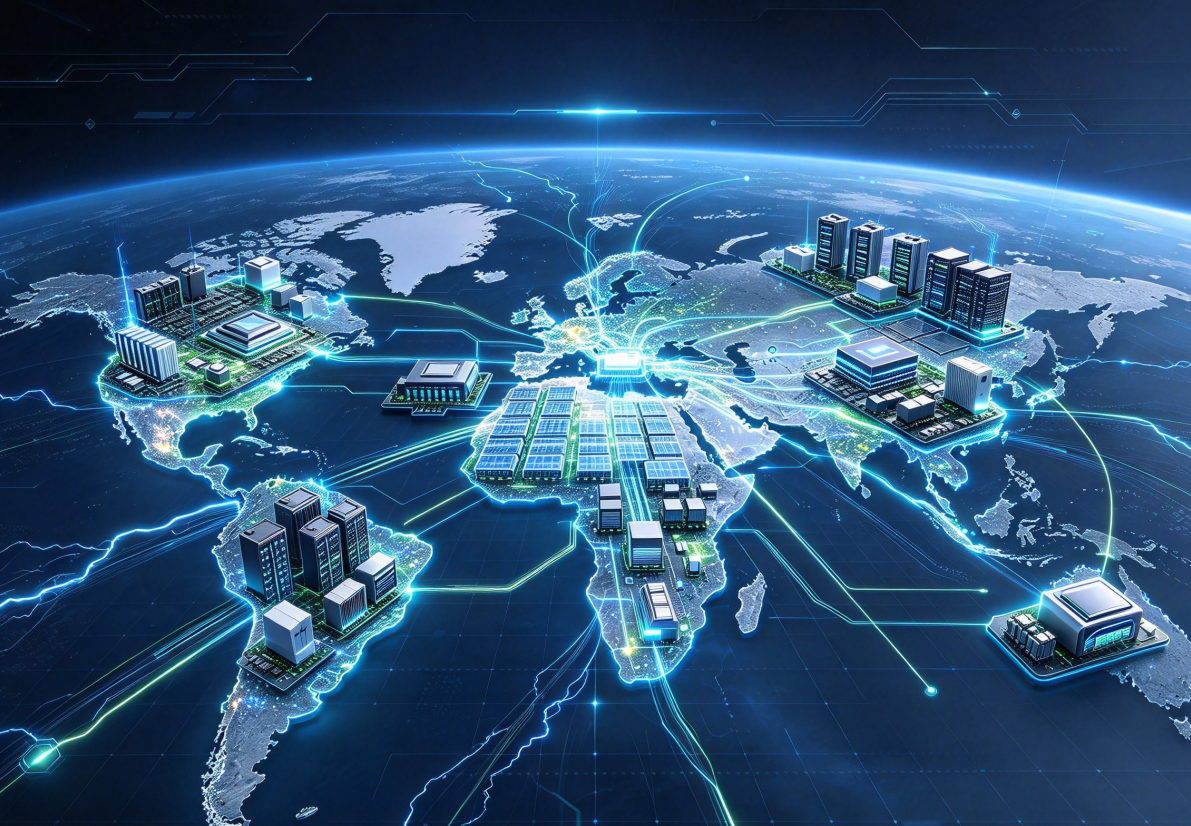
The United States leans toward a “technology export” model, China a “scenario iteration” model, and Europe and Japan an “industrial integration” model, with clear divergence in their driving logics and advantageous areas.
Fourth, the Middle East and emerging markets unlock latecomer potential through digital transformation. Driven by new-city development and digital transformation, the Middle East prioritizes fintech and urban governance AI applications and has delivered a batch of flagship projects. Emerging markets including India and Southeast Asia accelerate consumer AI adoption, riding demographic dividends and rising digital penetration.
Foundation models set the upper limit of AI capability; applications underpin the value base of AI. Competition at the application layer ultimately hinges on the maturity of industrial digitalization and richness of scenarios. Pure technological superiority seldom translates directly into market advantages in applications.
Stratified competition in the global AI industry does not equate to industrial fragmentation; it is a phenomenon arising from deepening global labor division. Future industry competition will gradually shift from isolated technology races toward rivalry over cross-chain coordination capacity, with compliance capability and energy costs emerging as key new dimensions of competition.
First, two noteworthy development trends to monitor. One is the likely persistence of a “concentration plus diffusion” pattern. Core foundation model technologies will probably continue concentrating in leading regions and among top vendors, while computing capacity and application use cases keep spreading into emerging markets, with both trends unfolding in parallel.
The other is that global AI governance rules will continuously shape regional niches. As economies enact AI regulatory legislation, compliance readiness will become a critical consideration for enterprises pursuing global expansion and further reinforce differentiated regional positioning.
According to 2025 reports from the OECD and European Commission, more than 30 economies have introduced dedicated AI regulatory frameworks, and regional divergence in governance rules is gradually emerging. This content is summarized from public documents; our entity makes no definitive prediction on the pace or outcomes of subsequent regulatory enforcement.
Second, implications for market participants. All market players may select suitable niches aligned with their resource endowments and avoid blind full-industry-chain expansion. For global deployment, firms can adopt a regionally stratified strategy, matching differentiated regional cooperation models to different tiers of the industrial chain.
Stratified competition reflects the alignment between regional resource endowments and industrial development strategies worldwide. Under the current landscape, all-round players covering the entire industrial chain are unlikely to emerge. Market participants are better positioned to identify niches compatible with their resource conditions.
In the long run, a single monopolistic system is unlikely to dominate the global AI industry. A multi-tiered, polycentric structure of coordinated labor division represents the likely direction of development, and regional characteristics will become more pronounced.
END
Disclaimer
All texts, research articles, market commentaries, industry analyses, compliance briefings, business explanations and related information published on this official website are for general industry information and macro market research reference only, intended solely for knowledge sharing and industry exchange. They do not constitute investment advice, wealth management recommendations, trading guidance, legal or compliance opinions, tax planning solutions or financing and M&A decision support for any individual, enterprise or institution.
ARBORFIRE CAPITAL conducts business in strict compliance with regulations of the SFC of Hong Kong, China, the US SEC and relevant domestic and overseas regulatory authorities. Content on this website is compiled and analyzed based on public, compliant market policies and industry materials. It contains no price forecasts, return guarantees, risk underwriting or investment promotion statements for any individual stock, fund or specific project. All historical market data and industry trend analyses are objective reviews and do not represent future market performance.
Cross-border capital operations, overseas listings, asset allocation, offshore structuring and family wealth management carry market risks, compliance risks and policy change risks. All users shall make independent and prudent decisions based on their own asset profile and risk tolerance, and consult licensed legal, tax and financial professionals when necessary. The Company accepts no legal liability for any decisions made or consequences incurred by users relying on content herein.
No party may reproduce, modify or commercially use content from this official website without official authorization from ARBORFIRE CAPITAL.


 热搜榜


